


- GEORGE’S SCHOOL, ALAKNANDA
REPORT ON DISASTER MANAGEMENT WORKSHOP
Safety Awareness and Training Programme on Disaster Management
Date: 22 October 2026
Participants: Students of Classes VII and XI
Introduction
St. George’s School, Alaknanda, organised a Safety Awareness and Training Programme on Disaster Management for the students of Classes VII and XI on 22 October 2026. The workshop was conducted by officials of the District Disaster Management Authority (DDMA), South, and the National Disaster Response Force (NDRF). The session was commenced by Inspector Ramphal in the gracious presence of our Respected Principal Ma’am, Ms. Anjali Massey, and the staff members. The programme aimed to sensitise the students to the nature of disasters and to equip them with practical skills in rescue and first aid.
Proceedings of the Workshop
- Awareness Session on Disasters and Rescue: The workshop began with an awareness session on disasters and rescue. The resource persons outlined five guiding principles: know the risk, build capacity, act in time, work together and recover better. Drawing on the Latur earthquake, the disaster in Nepal, the Bhopal gas leak, the super cyclone of 1999 and the Gujarat earthquake of 2001, they emphasised that disasters cause grave loss of life and property, that buildings must be made disaster-resilient, and that trained rescue teams are indispensable. Students learnt that the NDRF was constituted under the Disaster Management Act and works alongside the DDMA at the district level. The speakers also explained why school safety programmes and regular drills are essential, since disasters can strike at any time.
- Accident, Incident and Disaster: Students were helped to distinguish between an accident (a disturbance without loss of property), an incident (a similar event involving loss of property) and a disaster (a situation that cannot be handled by normal means and calls for specialised forces). They also learnt that disasters may be natural or man-made, and are classed as district, state or national according to the level of response required.
- Earthquake Safety: The resource persons explained that an earthquake is caused by the movement of tectonic plates and that the tremors typically last 20 to 30 seconds. Delhi lies in Seismic Zone IV, a high-risk zone, and framed buildings withstand tremors better than unframed ones. Students were taught to follow Drop, Cover and Hold On: stay calm, drop down, protect the head and neck, take shelter under a sturdy desk or table, hold on until the shaking stops, and then help others. Where no desk is within reach, they were advised to crouch against an inside wall or corner, shielding the head with their arms.
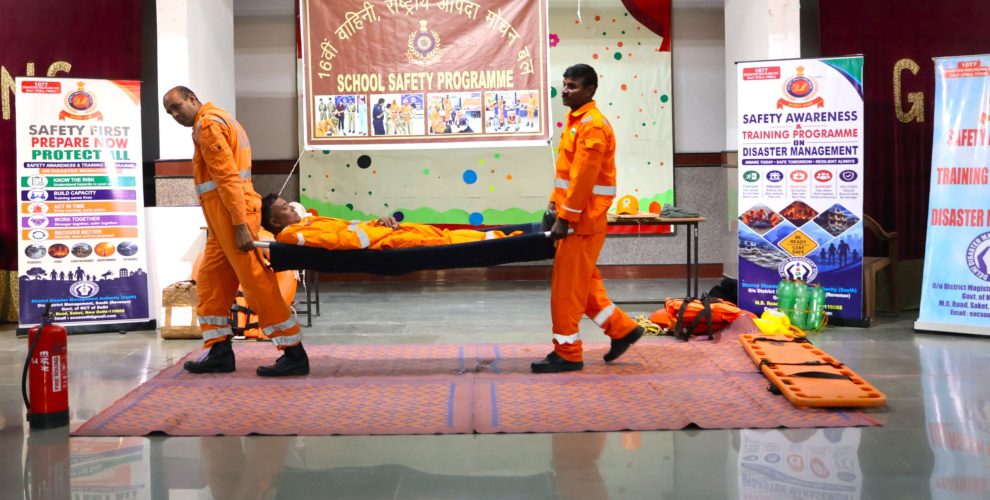
- Rescue Demonstration: The practical demonstration covered two kinds of rescue moves. In the emergency move, used when the casualty must be removed from danger at once, the rescuer, moving on the knees, folds the casualty’s collar to support the neck and draws the casualty clear of the debris using the collar hold or the blanket hold; the blanket hold is suitable only for distances of 15 to 20 metres. In the non-emergency moves, two rescuers carry the casualty using the two-hand carry or the four-hand carry. Students took an active part in each demonstration. An improvised stretcher, made from blankets, a sack, rope and poles, was then demonstrated, after which the students prepared one themselves, testing it on an uninjured person before use.
- First Aid: In first aid, students were taught to control bleeding by direct pressure, elevation, pressure point and tied pressure. They were reminded that an ambulance may take 15 to 20 minutes to arrive, so prompt action is vital and the time of injury should be noted. In a head injury, the head should be examined carefully from front to back for wounds and bleeding. A fracture is immobilised with an improvised splint made from a book, ruler, board or piece of wood.
- CPR Demonstration: Cardiopulmonary resuscitation (CPR) was demonstrated with the caution that it must not be practised unnecessarily. It is meant only for an unresponsive person who is not breathing normally and has no pulse, laid on a firm, flat surface; compressions are given in sets of 30, followed by two rescue breaths by those trained to give them. It must never be given to a person who has a pulse or is responsive.
- Flood Rescue: On flood rescue, students were shown how to make a life jacket at home from empty 5-litre cans. Throughout the session, they were reminded that a rescuer must ensure personal safety first.
- Address by Respected Principal Ma’am: The workshop concluded with an inspiring address by our Respected Principal Ma’am, Ms. Anjali Massey, who graciously extended her heartfelt gratitude to the NDRF and DDMA officials for their dedicated efforts and for the valuable training imparted to the students. Respected Ma’am emphasised that awareness is the foundation of safety and that preparedness saves lives. She further highlighted the need for similar sessions for both teachers and students, so that the entire school community is ready to respond calmly and effectively in an emergency.
Key Takeaways
- Preparedness and regular drills save lives.
- Buildings should be disaster-resilient; framed buildings withstand earthquakes better than unframed ones.
- In an earthquake, stay calm and follow Drop, Cover and Hold On.
- Correct rescue moves and improvised stretchers prevent further injury to the casualty.
- Bleeding must be controlled promptly and fractures immobilised before the casualty is moved.
- CPR is to be given only to an unresponsive person who is not breathing normally and has no pulse.
- A rescuer’s own safety comes first.
Conclusion
The Disaster Management Workshop was informative, practical and enriching. Students participated with enthusiasm and discipline, and the hands-on practice gave them confidence in basic rescue and first-aid skills. The session reaffirmed that safety begins with awareness, and that preparedness begins with each one of us.
The school gratefully acknowledges the District Disaster Management Authority and the National Disaster Response Force for conducting this valuable programme, which has helped build a safer and better-prepared school community.
Prepared by: Ms. Geetika
KEY HIGHLIGHTS
Disaster Management Workshop – Safety Awareness and Training Programme
Date: 22 October 2026
Participants: Students of Classes VII and XI
Resource Persons: Inspector Ramphal and Officials of the District Disaster Management Authority (South) and the National Disaster Response Force (NDRF)
Graced By : Respected Principal Ma’am, Ms. Anjali Massey
- The programme aimed to sensitise students to disasters and to equip them with practical skills in rescue and first aid.
- The resource persons explained five guiding principles: know the risk, build capacity, act in time, work together and recover better.
- Using the Latur earthquake, the Nepal disaster, the Bhopal gas leak, the 1999 super cyclone and the 2001 Gujarat earthquake as examples, they stressed that buildings must be disaster-resilient and that trained rescue teams are indispensable.
- Students learnt to distinguish between an accident, an incident and a disaster, and that disasters may be natural or man-made and are classed as district, state or national.
- Students were told that Delhi lies in Seismic Zone IV, that framed buildings withstand tremors better than unframed ones, and that during an earthquake they should follow Drop, Cover and Hold On.
- The rescue demonstration covered emergency moves (the collar hold and the blanket hold) and non-emergency moves (the two-hand and four-hand carries), and students prepared and tested an improvised stretcher.
- In first aid, students were taught to control bleeding through direct pressure, elevation, pressure point and tied pressure, to examine the head carefully in a head injury, and to immobilise a fracture with an improvised splint.
- CPR was demonstrated with the caution that it is meant only for an unresponsive person who is not breathing normally and has no pulse, and that it is given in sets of 30 compressions followed by two rescue breaths.
- Students were also shown how to make a life jacket from empty 5-litre cans, and were reminded throughout that a rescuer must ensure personal safety first.
- In her concluding address, our Respected Principal Ma’am, Ms. Anjali Massey, thanked the NDRF and DDMA officials for the valuable training, emphasised that awareness is the foundation of safety and preparedness saves lives, and highlighted the need for similar sessions for both teachers and students.
- The workshop was informative, practical and enriching, and the students participated with enthusiasm and discipline, gaining confidence in basic rescue and first-aid skills.


Leave a Reply